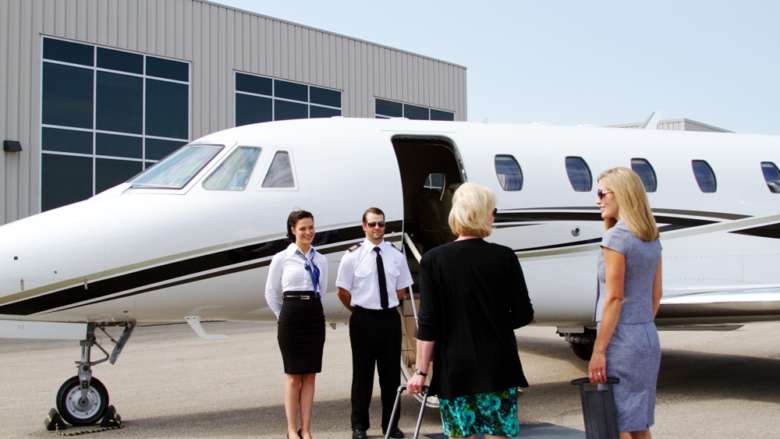
Private jet planes, which until recently were part of the status of heads of multinational corporations and eccentric billionaires, are getting closer to the people. And if the option of joint ownership of a winged aircraft, although more economical than full-fledged ownership, still requires a decent investment and maintenance, the option of renting an empty leg of a private jet looks much more affordable. The latter option even more reduces the cost of the possibility of organizing joint flights (the principle of sharing economy), when an airplane on the “free shoulder” is chartered for several clients with a shared cost. In addition, modern mobile and internet services make this kind of private jet use even more convenient. Another factor in the growth of air travel was the entry into the market of very light private jets (Very Light Jet, VLJ) for 4 passengers. The cost of a flight on a VLJ is on average 22% lower than on a standard size business jets.
It all started back in the middle of the last century, recovering from a devastating world war, the global economy demanded more active interaction in the business community. The traditions of that time required the personal participation of senior management in discussing important transactions and conducting negotiations with partners, and the globalization of business that began rapidly increased the area of interest and shortened the maximum interaction time for making decisions. Considering that neither mobile communications nor the Internet existed at that time, the business world was in dire need of an increase in the number of air travel, especially in the private air transportation sector and, as a result, in the center of the world economy – in 1964, the world's first private jet company appeared in the United States. air travel and business jet management Netjets Inc.
The company's business model was not just non-standard, it was a breakthrough management innovation in the field of private air transportation: literally a part of a particular aircraft was sold to customers, depending on the value of which the number of flight hours of using the aircraft and a share in the payment for its maintenance depends on the value of which. Typically, the share is between a minimum of 50 and a maximum of 400 hours per year. However, about 30% of the cost of each aircraft remains on the balance sheet of Netjets, which also provides pilots. The key to the success of this business model is the fact that back in 1995, Netjets Inc., through its multinational financial conglomerate, Berkshire Hathaway Inc., completely acquired and has not yet resold, one of the richest people in the world and a financial guru of strategic investment – Warren Buffett. Today's private air travel market is developing rapidly and if 10 years ago 7 out of 10 new Netjets customers did not use these services before, now this figure has dropped to 3 out of 10. Three quarters of Netjets traffic is in the United States, but the European market is also a priority area for development.
The European private charter market is rather heterogeneous in its development, and if the average age of chartered aircraft over the past 7 years has grown from 4.8 to 7.1 years, Netjets is trying to regularly renew its fleet. The last major update was in 2014, when Netjets significantly rejuvenated its aircraft fleet, investing more than $ 17.6 billion in the purchase of new aircraft equipment (670 aircraft). The European branch of Netjets has a staff of 500 experienced pilots, who have 85 of their own and more than 700 partner aircraft makes up to 46 thousand flights a year to 5 thousand airports (including those inaccessible to commercial flights) in 120 countries around the world. Switzerland was chosen as the base center for placing Netjets in Europe, which is logical, since a fifth of all private Netjets flights in Europe are carried out from there, and 43.3% of them from Geneva.
Being the second, after the French Le Bourget (Bourget, Paris), the largest European center of private aviation and the undisputed leader of Swiss private aviation (for every 40 commercial flights there are 3 private ones), Geneva Airport works with such private air carriers as: Wijet, Jetsmarter, Victor, Privatefly , Air Charter Service, NetJets, LunaJets. Private jet traffic on one of the busiest European routes (Geneva-London-Geneva-Nice) is constantly increasing from year to year, in addition, growing in new directions. Even the significant economic downturn of the crisis year of 2008, which caused a slowdown in the private air transportation industry, did not have a significant impact on the main players, and the growth of private aviation traffic quickly resumed. This phenomenon is already putting large airports like Geneva almost on the brink of capacity, and in the very near future will force the administration to either engage in large-scale expansion, which is certainly very costly, or to divert part of private aviation traffic to nearby airports, guided by unclear selection criteria. The current situation can be significantly aggravated by the recently adopted change in the EU aviation regulations, which allow the commercial operation of small aircraft propeller driven aircraft (previously, this type of aircraft could only be used by the owner himself or at his expense). This will significantly increase both the supply of private air carriers with aircraft such as the Swiss Pilatus, and significantly worsen the overall situation with private aircraft traffic.
For example, during the European Business Aviation Convention & Exhibition (EBACE 2017), an annual aviation forum held at the end of May at the Palexpo convention and exhibition center (Canton Geneva), exhibited at the Geneva airport. This significantly reduced the airport's maximum capacity for receiving and dispatching flights, forcing the airport authorities to redirect part of the traffic (especially private) to the nearest Swiss airports Lyon or Chambéry.
Another, cheaper, but not always affordable way of flying in a private jet is to rent a “free shoulder”. On the busy routes of America and Europe, as a rule, it is not difficult to find such a flight with a discount of up to 75%, not only for private, but also for charter and even regular flights. Such situations arise, as a rule, during major social events (music festivals, sports competitions, etc.), when jammed planes carrying fans and fans are forced to return to their home port practically empty. As for private jets, it is possible to significantly reduce the cost of leasing on the “free shoulder” by using sharing services, when the total cost is equally divided among all passengers of the flight. One of the leaders in this segment is the French private air taxi company Wijet (Paris), which, following the acquisition last year of its British competitor, the first European business air taxi, Blink Ltd., became the owner of the largest European aviation fleet in the VLJ segment. Wijet plans to increase its fleet of aircraft from 15 to 50 by 2021 without losing the quality of services provided, and given the annual increase in profits, on average from 40% to 50%, this task does not seem so insurmountable.
The next logical step in the development of this area was to offer not only for passengers (saving ticket prices), but also for owners and operators of private aircraft (increasing the profitability of flights by maximizing the “free shoulder” load), at the system level combining all available information about private flights around the world. This idea was implemented by the Swiss private airline LunaJets (Canton of Geneva), its solution allows you not only to rent a private jet, fly away at the last minute (a full cycle from search to landing in just 60 minutes), but also save on ticket prices (JET SHARING service ), as well as to ensure the growth of the profitability of air carriers by providing a wide market of services (data on 4.8 thousand flights around the world) with daily updates on the website and in the mobile application. By the way, it is the market size that is one of the main key links to LunaJets' success – the more market participants, the more attractive it is for travelers looking for the right destination, and the more people who want to fly, the higher the probability of filling the cabin on an empty shoulder. LunaJets' management adheres to a strategy of organic growth, using its own funds, as this is consistent with the goals and capabilities of the company. Already, 35 LunaJets employees provide an “explosive” growth in the demand for private air transportation by 60% since the beginning of the year, which allows us to estimate the prospective volume of traffic for 2017 about 3.5 thousand flights (in 2016 there were 2.5 thousand), with the average cost of a ticket is about $ 20 thousand. These revenues fully ensure expansion into the world market and have already allowed the company to open representative offices not only in large aviation hubs such as London, Paris and Rome, but also in regional airports: Greek Mykonos, Spanish Ibiza, Italian Olbia, French Palma de Majorque, as well as in Poland and Hungary.