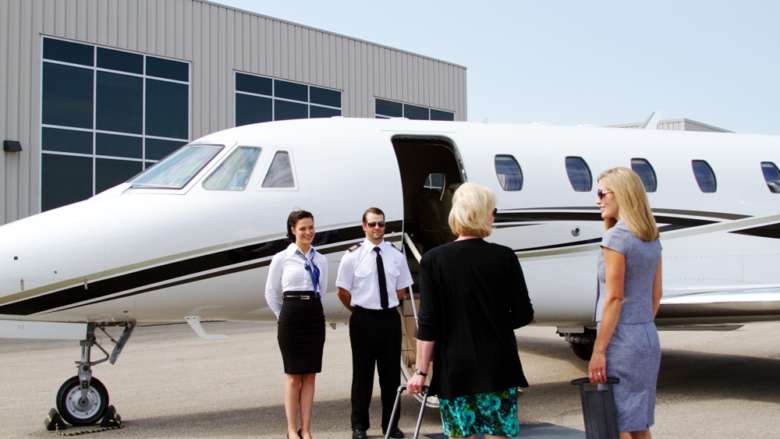
Private flights are no longer a luxury service for the oligarchic circle, as it was in the early 2000s. Over the past six years, the number of flights departing from Vnukovo (90% of business aviation flights are operated through this airport in Russia) has increased sixfold.
It all started with personal accounts on the websites of brokers and an order form, which was offered as an alternative to booking via the phone (although a substantive discussion was then still held by phone). Then more than a dozen applications appeared for ordering “jets” via the Internet. About three years ago, the digital wave reached Russia.
But the main change affected the composition of the audience. In 2017, according to the statistics of “Your Charter”, up to 15% of private flights began to be accounted for by people who were difficult to imagine on board a jet 10 years ago.
Recently, the media hotly discussed the story of the founder of the Rocketbank service, Oleg Kozyrev, who came to a meeting with a realtor to inspect an apartment near the Kropotkinskaya metro station in Moscow, which was rented out for several hundred thousand rubles. Kozyrev came in jeans and a sweater, and his girlfriend in sneakers with the words “Hey baby”, and the real estate agent did not even let them into the apartment, slamming the door in front of them. In general, people like Oleg Kozyrev (of course, I'm not talking about him specifically, we cannot call clients by their names) now not only rent elite housing, but also fly private flights, and air brokers, unlike realtors, to such clients are not surprised.
A new generation of entrepreneurs
In the 2010s, it became especially noticeable in Russia how the class of rich people was expanding. Now money can be earned faster, thanks to high technologies – it is not necessary to work hard all your life as before, so the audience of business aviation is getting younger and, for example, bankers of a new wave are joining it. We are not talking about top managers of the largest financial organizations, such as Alfa-Bank (these have been flying for a long time) or Gazprom (they generally have their own aircraft fleet). There is a whole galaxy of entrepreneurs who in the 2000s opened projects related to the so-called IT banking, or card programs. Now the business has taken place, and they are reaping the fruits of their labor.
The same category includes Russian business aviation passengers, who at one time invested in IT projects, and are still engaged in investments, but moved to live in Europe. They regularly fly in private jets within Europe, from Europe to Russia and back. An interesting new segment is gamers. They also began to use private jets: if a team of e-sportsmen flies to a tournament with a prize pool of $ 10 million, then they can quite afford to fly a round-trip charter, spending € 30,000- € 50,000, which we observe in practice.
The presence of the Internet on board has become mandatory. Previously, we tried to watch movies online, now communication is needed mainly for work – for instant messengers and news channels. And although it is very expensive (in the region of $ 9 per megabyte), passengers are not stingy. One of our first clients, a large Russian businessman, demanded the presence of the Internet, regardless of cost, even before it became a clear trend. He very often flew to the United States, was constantly in touch, and the surcharge for the Internet in flights was calculated in thousands of euros. Later it turned out that this passenger became one of the shareholders of Facebook and several other IT giants, the Internet became an investment tool for him.
After the 2014 crisis, we expected the market to fall, but due to new customers, it did not sink. However, in monetary terms, its volume decreased. Flight prices have dropped by about 20% since the early 2010s. The reason is that the airline brokers who sell flights have become price-competitive. But if you look at it, it was IT passengers who influenced the price competition.
Private jet brokers
To be honest, there is nothing difficult in the broker business. About 90% of all charters are booked through one international platform Avinode. To get started, it is quite enough to learn how to handle it by working with one of the existing brokers, and then open an LLC and say that you are a broker yourself, so now there are about 50 air brokers in Russia, including loners and companies where they work dozens of people. The hardest part will begin further: an entrepreneur needs to look for clients, and this process has always been based on personal connections and loyalty. Brokers could compete in price before, but if earlier this strategy did not bear fruit, then recently it suddenly started working.
Old clients most often ordered jets through an assistant, and those same IT entrepreneurs call themselves, understand airplanes themselves and relate to the service easily: “Do you have such a flight? How much is? Let's fly! “. These clients realized that the service was not so exclusive and began to demand that it be cheaper. Personal relationships, of course, still play a role, but the client can easily change broker and get the best price.
The era of high margins has passed and the era of technology has arrived. At the start of this era, more than a dozen IT startups appeared, which were launched by brokers. Aviaplaza, Aviadome, Charter Luxury, Flight List Pro, FlyEasy, Fly Victor, JetHunter, Jetsmarter, Jetonair, Stratejet – and this is not a complete list. All of them, one way or another, play up two components: ordering a jet through a website or mobile application and reducing the price due to the original business model.
For example, the Russian-based startup JetHunter (Forbes wrote about it in detail, but at the moment the service has already ceased to exist) has released a platform where passengers book flights, after which airlines fight for customers in a downgrade auction format. The idea didn't work, and the startup made a pivot and started selling Empty Legs flights. This is the name of the flights of aircraft that have already delivered the client to their destination and return empty to the airport of departure.
Now the majority of technology startups in business aviation are trying to play on the sale of Empty Legs. There are even airlines that offer online jet booking and offer Empty Legs within their fleet only, and even on membership fees. This is done, for example, by the airline VistaJet, whose business model resembles something like a closed club for thrifty passengers.
Our project GetJet, which we launched for professional market participants – brokers and travel agencies, also exploits the idea of saving, but in a slightly different way. The system automatically combines flights ordered in different directions. Its task is to prevent the appearance of Empty Legs and immediately reduce the cost of both flights – the plane's flight to another airport and its return. If this fails, the system looks for a regular Empty Leg.
Service culture
However, it is still impossible to determine which business model will take off and turn out to be the most widespread. The catch is that people from the IT industry, although they set the tone for the market, are still in the minority. Only a third of jet passengers are now ready to use online applications, and the rest still want to discuss flights through assistants. However, real changes will begin very soon.
Young IT entrepreneurs have “rocked” the aviation brokers, now we are “rocking” the rest of the business aviation passengers and attract new ones. JetHunter tried to transfer to jets, including business class passengers, by launching a joint campaign with Aviasales. Another startup, JetSmarter, launched a wide advertising campaign inviting media personnel (rapper Jay-Z is among the shareholders of this startup), offering to “catch” free flights on Empty Legs flights. In five years, some of us will finally become as strong a player as Uber is in the taxi market.
One of our top clients (included in the top 50 Forbes) admitted that the feeling of uniqueness and exclusivity from flying on jets has long gone, and even the presence of other passengers, if it lowers the cost of the flight, will not embarrass him. Rather, on the contrary, it will be more fun to chat with the new wave entrepreneur in flight if he happens to be a fellow traveler.